New Jersey Dog Registration Information
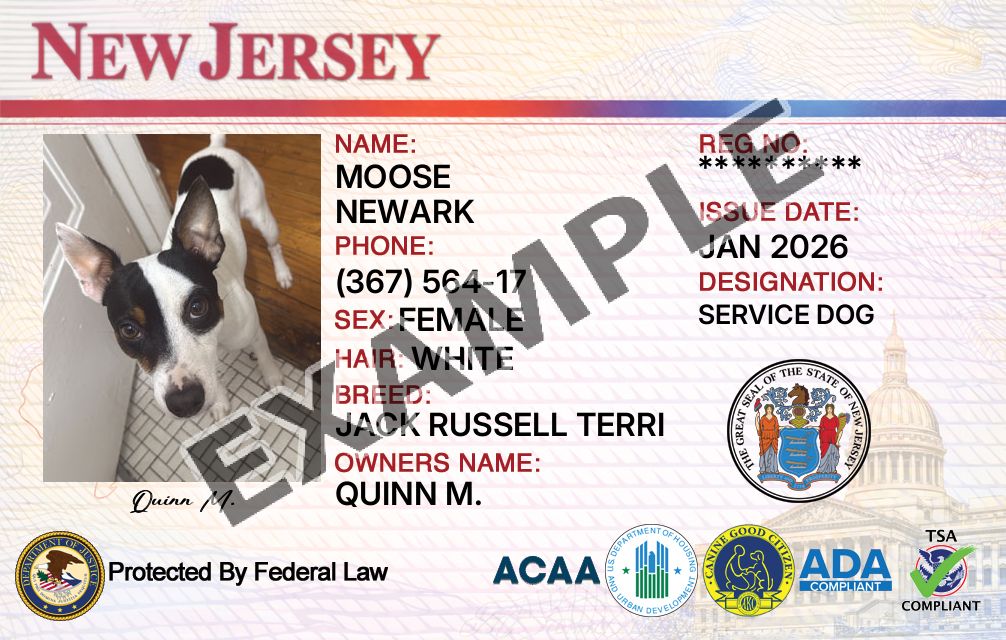
State Licensed, Service Dogs and Emotional Support Dogs in New Jersey
If you’re asking, “where do I register my dog in New Jersey for my service dog or emotional support dog?” the most important thing to know is this: New Jersey does not have a single statewide “service dog registry” or “emotional support animal registry” that you must use.
What most people mean by “register” is getting a dog license in New Jersey. In NJ, dog licensing is generally handled locally—usually through your municipal clerk or local health department—and it is closely tied to rabies vaccination requirements. This page explains where to register a dog in New Jersey, what “registration” actually means for service dogs and ESAs, and how animal control dog license New Jersey enforcement typically works at the local level.
Where to Register or License Your Dog in New Jersey
Because licensing is handled locally, you typically register (license) your dog with your city/township/borough. Below are examples of official New Jersey offices that publish dog licensing information or provide animal control/health department support for licensing and rabies compliance. Availability and processes vary by municipality, so use these as examples of the kinds of official offices to look for where you live.
Example Office: Hoboken Division of Health (Dog Licensing / Rabies)
- Street address: 124 Grand St, 2nd floor
- City/State/ZIP: Hoboken, NJ 07030
- Phone: (201) 420-2000 x 1621
- Email: healthdivision@hobokennj.gov
- Office hours: M–F, 9am–4pm
Example Office: Jersey City Division of Animal Care & Control (Dog Licensing)
- Office name/location: Jersey City Animal Shelter (Division of Animal Care & Control)
- Street address: 235 Jersey City Blvd.
- City/State/ZIP: Jersey City, NJ 07305
- Phone: (201) 547-4888
- Email: animalcontrol@jcnj.org
- Public hours: Tue–Sun, 12pm–5pm (Monday: Closed)
- Additional note: “Facility is Open Seven Days a Week 8AM–5PM by Appointment Only.”
Example Office: Cherry Hill Township Municipal Clerk (Pet Licensing)
- Street address: 820 Mercer Street, Room 107
- City/State/ZIP: Cherry Hill, NJ 08002
- Phone: (856) 488-7892
- Office hours: Monday–Friday, 8:30 a.m. to 5 p.m.
Example Office: Princeton Health Department
- Street address: 1 Monument Drive, Monument Hall
- City/State/ZIP: Princeton, NJ 08540
- Phone: (609) 497-7608
- Office hours: Monday–Friday, 9am to 5pm
- Email: (listed as “Email the Health Department” on the official page; no visible address provided)
How to find the correct office for your town
- Search your municipality’s official site for “dog license,” “pet licensing,” “municipal clerk dog license,” or “health department dog licensing.”
- If you can’t find it, call your municipal clerk and ask who issues dog licenses and where to submit rabies proof.
- If you’re dealing with enforcement questions (bites, nuisance, running at large), ask for animal control or the local health department.
Overview of Dog Licensing in New Jersey
What “registering your dog” usually means
In New Jersey, “registering” typically means obtaining an annual local dog license through the municipality where the dog is kept. The State explains that owners of dogs (commonly described as seven months of age or older) must apply annually to the licensing clerk in their municipality, and the license can’t be issued without appropriate rabies vaccination proof (or a qualifying exemption). Municipalities set their own licensing fees by ordinance, within state limits.
Why the dog license matters (beyond a tag)
A local license generally comes with an official tag. If your dog is found, a license tag can speed up reunification. Licensing also supports local public health efforts related to rabies control and helps municipalities maintain records that animal control may rely on during bite investigations or nuisance complaints.
How Dog Licensing Works Locally in New Jersey
Step-by-step: where to register a dog in New Jersey (typical process)
- Confirm which office handles licensing in your town (often the Municipal Clerk or Health Department; sometimes an Animal Control division manages intake).
- Get a rabies vaccination certificate from a licensed veterinarian (see rabies requirement details below).
- Complete the local dog license application (online, mail, or in person depending on the municipality).
- Provide required documents (rabies certificate; sometimes proof of spay/neuter to determine fees; sometimes proof of address).
- Pay the local licensing fee (amount and renewal schedule are set by municipal ordinance).
- Receive your license and tag, and keep the tag attached to your dog’s collar/harness as required by local rules.
Rabies vaccination rules tied to licensing
New Jersey’s licensing process is tied to rabies control. State regulations require licensing officials to see evidence the dog has been inoculated against rabies, and that the vaccine’s immunity extends through at least ten months of the twelve-month licensing period. If a veterinarian certifies in writing that a dog cannot be vaccinated due to a medical condition or therapy regimen, an exemption may be granted by the licensing official based on that certification.
Local differences you should expect
Different renewal calendars
Some towns run dog licenses on a calendar year; others have specific annual renewal windows and late fees. Always verify your municipality’s renewal dates and penalties.
Different submission methods
One town may require in-person paperwork, while another allows online applications or mail-in renewals. The “right place” to register is whichever official office your municipality designates.
How animal control may be involved
When people search for animal control dog license New Jersey, they’re often trying to find the office that can answer licensing enforcement questions (tags, renewals, bite quarantine rules, lost dogs). In some municipalities, animal control or an animal services division provides the “front door” for licensing questions, even if the license is ultimately issued by the clerk/health department.
Important: licensing is not “service dog registration”
Your dog’s local license is a government-issued license/tag tied to vaccination and residency—not a certification that your dog is a service dog or an emotional support animal. A dog can be licensed and still be a pet, an ESA, or a service dog; licensing is typically required regardless of working status, and the local office may not ask for (or issue) any “service dog registration” paperwork.
Service Dog Laws in New Jersey
What makes a dog a service dog
A service dog is generally understood as a dog that is individually trained to do work or perform tasks for a person with a disability. The legal status comes from the handler’s disability-related need and the dog’s task training—not from buying a certificate online, not from a vest, and not from entering a dog into a database.
Does New Jersey have a required service dog registry?
For most residents, there is no required statewide “service dog registration” step to complete in order for a dog to be a service dog. The practical requirement you’ll still need to meet is usually the standard dog license in New Jersey through your municipality, plus keeping rabies vaccination current.
Service dogs vs. dog licensing
- Dog license: Local municipal license/tag for dogs kept in town; tied to rabies vaccination and local ordinances.
- Service dog status: Disability-law concept; depends on disability-related need and training to perform tasks.
- What you “register”: In practice, you register/license the dog with your municipality; you do not usually “register” the dog as a service dog with the State of NJ.
What to bring when licensing a service dog
For licensing, municipalities typically focus on the same basics: rabies certificate, payment, and your information. If you’re seeking any local fee waiver or special tag policies (which vary by town), ask your municipal licensing office directly what documentation they require—if any—because these are local policy questions, not a universal “service dog registry” process.
Emotional Support Animal Rules in New Jersey
What an ESA is (and is not)
An emotional support animal (ESA) is typically an animal that provides comfort by being with a person who has a disability-related need for that support. ESAs are most commonly discussed in the context of housing accommodations. An ESA is not the same as a service dog, and an ESA generally does not receive the same public-access rights as a service dog.
Do you register an ESA with New Jersey?
Usually, no. You generally do not “register” an ESA with the State of New Jersey or your town as a special legal category. What you typically must do is:
- Maintain standard compliance like a dog license in New Jersey through your municipality (if your dog meets licensing age rules).
- Keep rabies vaccination current and retain the certificate.
- Work with a housing provider if you are requesting an accommodation related to your disability (documentation processes can vary based on the situation).
ESA paperwork vs. licensing paperwork
Municipal licensing paperwork
Primarily proves rabies vaccination compliance and local licensing/fee payment. Issued by your local municipality (clerk/health department).
ESA support documentation
Typically relates to a disability-based need and is used for housing accommodation requests. This is separate from municipal dog licensing and is not a “license tag” process.
Frequently Asked Questions
Disclaimer
Licensing requirements and office locations may change. Residents should verify details with their local animal services office within New Jersey.
Register A Dog In Other New Jersey Counties
Select your county from the dropdown below to get started with your dog’s ID card. Requirements and license designs may vary by county, so choose your location to see the correct options and complete your pup’s registration.
- Atlantic County Dog Registration
- Bergen County Dog Registration
- Burlington County Dog Registration
- Camden County Dog Registration
- Cape May County Dog Registration
- Cumberland County Dog Registration
- Essex County Dog Registration
- Gloucester County Dog Registration
- Hudson County Dog Registration
- Hunterdon County Dog Registration
- Mercer County Dog Registration
- Middlesex County Dog Registration
- Monmouth County Dog Registration
- Morris County Dog Registration
- Ocean County Dog Registration
- Passaic County Dog Registration
- Salem County Dog Registration
- Somerset County Dog Registration
- Sussex County Dog Registration
- Union County Dog Registration
- Warren County Dog Registration